Willemstad's Architecture: 743 Listed Buildings and One Very Good Story
Updated September 24, 2026 · 8 min read
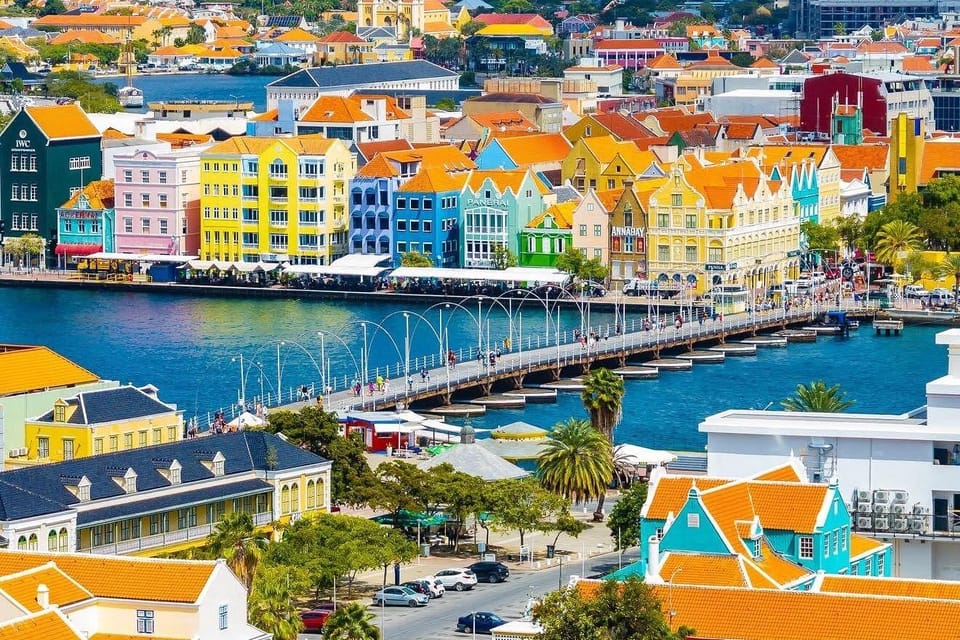
Almost everyone arrives at the same photograph and leaves with the same explanation: the houses are painted in colours because a governor got headaches from the white. It is a wonderful story. It is also the least reliable thing anyone will tell you here.
What is documented is more interesting, and it is the reason the city carries a World Heritage listing rather than a postcard.
What is actually protected
The Historic Area of Willemstad, Inner City and Harbour was inscribed on the UNESCO World Heritage List in 1997. The listing covers four districts — Punda and, behind it, Pietermaai and Scharloo on the eastern side of St Anna Bay, with Otrobanda facing them across the water.
The numbers behind it are worth knowing before you walk in. The historic inner city contains 743 listed monuments, and the island as a whole has more than 860 protected buildings and archaeological sites (Curaçao Monuments Foundation). Those 743 are not all mansions. Most are ordinary shops, townhouses and small homes, which is precisely why the place still works as a city rather than a museum.
The urban structure grew outwards from Fort Amsterdam, begun in 1635 on the eastern bank. Punda is the seventeenth-century core; the other three districts are largely eighteenth and nineteenth century. Most of what stands dates from 1650 to 1900.
The form: an Amsterdam gable with a veranda bolted on
Stand in front of the Handelskade row and read it from the top down. The gables are Dutch — stepped, bell-shaped, scrolled, the same vocabulary you would find on a canal in the Netherlands, built by merchants who wanted their houses to look like home.
Everything below the gable is a negotiation with the climate. Ceilings rise to move hot air. Shutters shade the windows. Deep galleries and verandas run along the fronts and sides, so the living space is outdoors and in shadow at the same time. Roofs are tiled in red, often on a steep pitch that makes no sense for rainfall here and perfect sense as an imported habit.
That hybrid — northern European façade, Caribbean plan — is the thing UNESCO listed. The colours came later, and they are paint.
The colour story, told honestly
The version you will hear: in 1817, Governor-General Albert Kikkert decreed that houses could no longer be whitewashed, because the glare of the tropical sun on white walls was damaging to the eyes, and — depending on who is telling it — to his own head.
Two problems. The story is repeated constantly without anyone producing the document, and coloured façades on the island are recorded before Kikkert arrived. Historians who have looked at it treat the migraine version as folklore; the more prosaic explanations on offer are that colour helped sailors tell buildings apart on approach, and that paint was simply available and fashionable.
So: repeat the story if you like it, but do not repeat it as fact. The honest version — nobody has shown the decree, and the custom seems older — is a better thing to know while standing in front of the wall.
The predominant shades are ochre, blue, green and red, and they are repainted regularly. Part of what you are photographing is maintained appearance, kept up because it is the island’s most valuable image.
District by district, and what each is worth
Punda is the oldest and the busiest. Narrow shopping streets, the floating market on the Waaigat, and the buildings that sit in every photograph. Come early, before the cruise arrivals land; it changes character completely by ten in the morning.
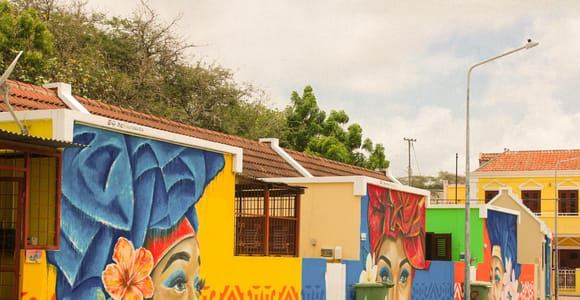
Otrobanda is denser, poorer historically, and far more rewarding to walk. It grew as a district of smaller houses and yards rather than merchant frontages, and large parts of it are still awaiting restoration — collapsed roofs, propped façades, buildings with trees growing out of them, two streets from a restored museum quarter. This is where you see the actual condition of the heritage rather than its best face. It is also where most of the mural painting is, which we cover in our guide to local culture in Willemstad.
Scharloo is the one visitors miss. When Punda filled up, wealthy merchant families — many of them from the Sephardic Jewish community — built along the wide streets across the Waaigat, and they built to be seen: neoclassical and Art Nouveau detail, ornate plasterwork, deep verandas, houses that stand alone in their own plots. The most photographed is the one everybody calls the Bolo di Bruid, the wedding cake house. Several of the others are in office use, so you are looking from the pavement.
Pietermaai was nearly lost. A district of eighteenth-century dwellings and grander nineteenth-century houses, it fell into serious decay and has been progressively restored over the past two decades into hotels, bars and restaurants behind the original fronts. It is the clearest example on the island of restoration paid for by hospitality — and, depending on your view, of what that does to a neighbourhood.
The landhuizen, which are the other half of the story
Outside the city stand the landhuizen — the plantation houses. They are usually a single-storey block with a high tiled roof, dormers and gallery wings, set deliberately on a rise so the owner could see the land and be seen from it. Estimates of how many were built run to around 160, of which roughly 60 survive in some form; the counts vary by source and by what you accept as surviving.
They are not a neutral heritage. These were the seats of an agricultural economy worked by enslaved people, and the better museums on the island say so directly rather than selling the houses as romantic.
Two are easy to fit into a day. Landhuis Jan Kok, in the west near the salt pans, has stood in its present form since 1840 and is one of the oldest estates on the island. Landhuis Chobolobo, in the city, is the odd one out: it stands in the middle of the city rather than on a rise above the land, and it is still in use rather than on show. Senior & Co bought the early-19th-century house in 1947 and turned it into the distillery where the blue liqueur is made — the visiting details, tour times and prices are in our local culture guide.
Seeing it with someone who knows the buildings
You do not need a guide for the façades. You do need one for the lintels, the dates, the family names and which rebuilt wall is a rebuilt wall.
The colourful history walking tour is 2 hours at €32.50 with 4.6 stars from 168 reviews and crosses both banks on foot — the second most-reviewed city walk in our inventory, behind the €19.68 highlights tour. It is not suitable for wheelchair users or people with mobility impairments, and the operator also excludes pregnant women and babies under one.
If you would rather combine the buildings with the distillery, the city, culture and Blue Curaçao tasting tour runs €57.10 with hotel pickup and takes in Chobolobo and the handcraft market. It carries 4.8 stars, but from only 14 reviews — a small sample, and worth reading them rather than trusting the average.
There are 35 Willemstad city tours from €12.99 in total, and for the plantation houses you want the 45 island tours from €24.60, since the landhuizen are spread across the west and a city tour will not reach them.